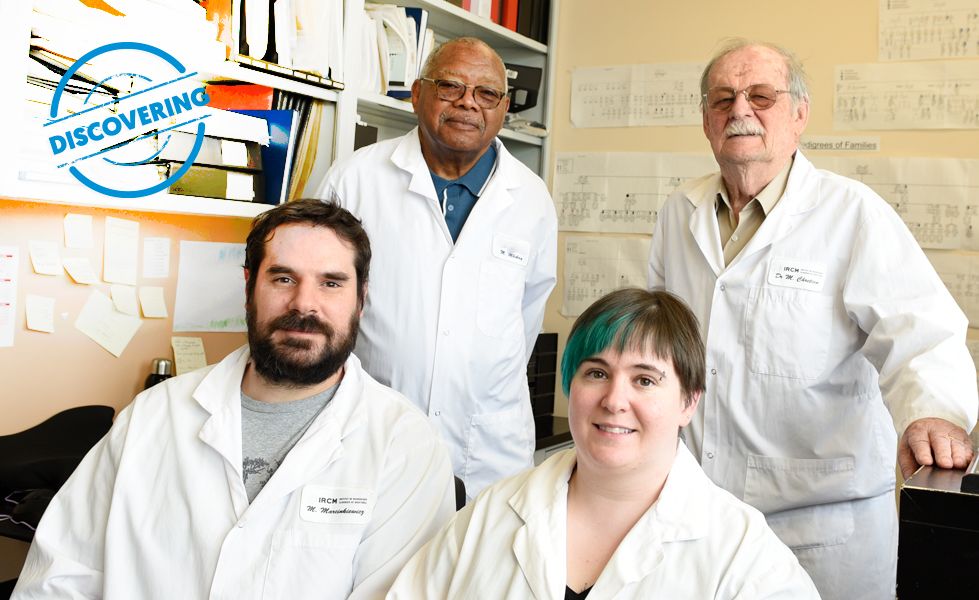
An international collaboration led by the IRCM sheds light on research against future pandemics.
De gauche à droite : Baptiste Coutaud, Majambu Mbikay, Annie Roy, Michel Chrétien
Montreal, April 29, 2026 — At a time when the global scientific community fears the sudden emergence of new pandemics, researchers at the Montreal Clinical Research Institute (IRCM) are continuing the search for novel antiviral agents derived from natural sources.
In a study published in early March 2026 in the prestigious Journal of Natural Products of the American Chemical Society (ACS), a scientific team led by Drs. Michel Chrétien and Majambu Mbikay of the IRCM’s Functional Endoproteolysis Laboratory identified a new family of natural molecules with strong antiviral activity, notably against the Ebola virus, and SARS-CoV-2, the virus responsible for COVID 19.
A Scientific Puzzle Solved After Ten Years of Work
As early as 2016, and again in 2020, IRCM researchers demonstrated that a plant extract rich in isoquercitrin—a flavonoid found in many plants—exhibited strong antiviral activity in the laboratory. One critical question, however, remained unanswered: was this effect truly due to isoquercitrin itself, or to compounds present in very small amounts within the extract?
To resolve this key scientific puzzle, Dr. Majambu Mbikay and research assistant Annie Roy at the IRCM, undertook the herculean task of finding the “needle in the haystack,” an effort that required nearly 30 months of intensive research.
They established a tripartite collaboration with Dr. Guido F. Pauli, a chemist and leading expert in natural products at the University of Illinois, in Chicago, and Dr. Logan Banadyga, Director of the Department of Molecular Virology at Canada’s National Microbiology Laboratory in Winnipeg.
Two Rare but Exceptionally Potent Molecules
Using cutting edge analytical methods and a rigorous, bioassay guided approach, the team demonstrated that the antiviral activity did not originate from isoquercitrin itself, but rather from two previously unknown triterpenoid compounds present at only 0.4% of the analyzed extract.
These newly identified molecules, named dicitriosides, proved to be up to 25 times more active than the original extract against Ebola virus and SARS CoV 2 under experimental conditions, showing efficacy at pharmacologically achievable concentrations.
“This discovery illustrates how compounds present in vanishingly small amounts in nature can have major therapeutic potential,” explains Dr. Mbikay. “It also underscores the importance of carefully examining the true composition of natural products used in biomedical research.”
International Recognition
The findings quickly drew the attention of the international scientific community. The ACS selected the article as one of the top papers of the week and featured it on April 13, 2026, as an editorial highlight in C&EN News (Chemical & Engineering News), the ACS’s flagship weekly publication read by nearly 300,000 scientists worldwide.
A Pan Canadian and International Collaboration
This serendipitous discovery is the result of a broad, interdisciplinary collaboration between the IRCM, the University of Illinois in Chicago, and the National Microbiology Laboratory of the Public Health Agency of Canada (PHAC) in Winnipeg, which houses highly secure facilities for handling extremely dangerous viruses. The study also benefited from support from PHAC (Canada), the NIH and NSF (United States), and several foundations: Richard and Edith Strauss (Montreal), Aclon (Geneva), J. Louis Lévesque (Montreal), Écho (Montreal), the Lazaridis Family (Waterloo), Power Corporation of Canada (Montreal), and Notre Dame de Zeitoun (Montreal).
A Major Contribution Toward Preparing for Future Pandemics
“Although this work is still at the preclinical stage, it opens promising avenues for the discovery of new broad spectrum antivirals derived from natural products,” the authors state. However, much work remains to be done.
“No one knows when the next pandemic will occur, but one thing is certain: we must be prepared,” emphasizes Dr. Michel Chrétien. “These results demonstrate the importance of long term fundamental research and international collaboration in anticipating the public health challenges of the future.”