A Team Led by Dr. Hideto Takahashi Identifies a Molecular Mechanism Essential for the Stability of Neural Connections
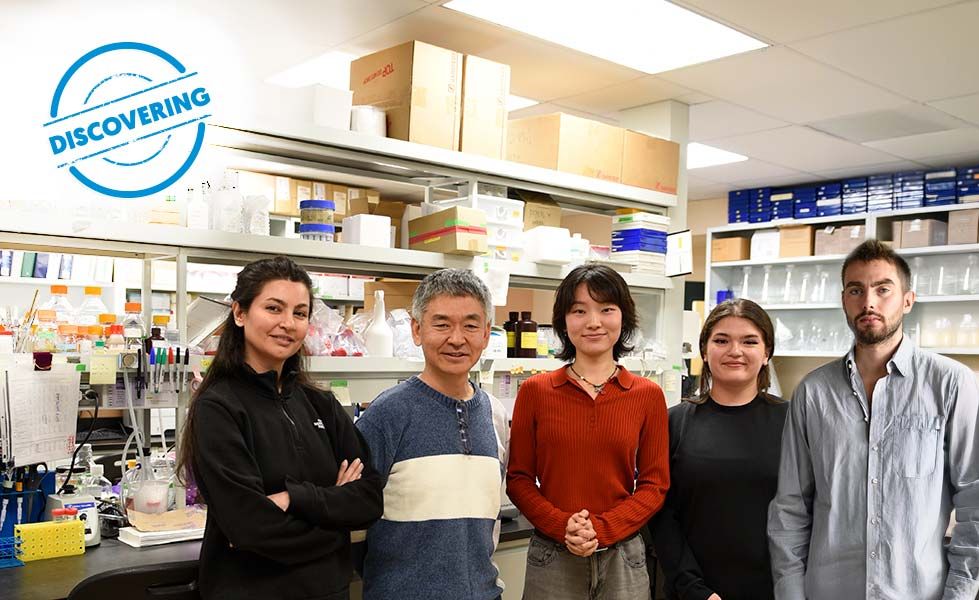
From left to right: Parisa Zarei (postdoctoral fellow), Dr. Hideto Takahashi (research director), Manni Wang (Ph.D. student), Maia Fukuyama-Kaplan (Ph.D. student), and Nicolas Chofflet (Ph.D. graduate and first author of the study)
Scientists at the Montreal Clinical Research Institute (IRCM), led by Dr. Hideto Takahashi, have uncovered a fundamental mechanism that helps maintain the stability of connections between nerve cells in the brain. First authored by Nicolas Chofflet, a PhD student in Takahashi's laboratory who played a major role in the research, and published in Nature Communications, the study provides new insights into biological differences between males and females in neurodevelopmental and neuropsychiatric disorders, including autism spectrum disorder and anxiety disorders.
The team discovered that a pair of proteins, Vstm2b and Nrxn2α, act like a molecular key and lock that stabilizes synapses, the essential contact points through which neurons communicate with one another. This mechanism is particularly important in the ventral hippocampus, a brain region involved in emotions, anxiety, and social behaviour.
“Synapses must be carefully maintained to ensure that neural networks function properly. We identified Vstm2b as a critical molecular partner for Nrxn2α, allowing us to better understand how specific neural connections are established and maintained during development,” said Dr. Hideto Takahashi, IRCM researcher and senior author of the study.
A Major Step Forward in Understanding the Brain
Until now, scientists did not know which molecule specifically binds to the autism-linked protein α-Nrxn to support the maintenance of excitatory synapses, which are essential for information processing in the brain. Vstm2b is the first molecule identified that specifically interacts with Nrxn2α to regulate the maintenance of excitatory synapses.
By deleting the Vstm2b protein in mice, the researchers further observed distinct effects in males and females. These differences were reflected both in the way certain excitatory synaptic connections were stabilized during development and in behaviours related to anxiety and social interaction.
The findings provide important new clues about the biological mechanisms that may contribute to sex differences observed in a range of neurodevelopmental and mental health disorders.
“Our work shows that the mechanisms supporting the stability of brain circuits are not necessarily the same in males and females. A better understanding of these differences will be essential for developing more personalized and potentially more effective therapeutic approaches in the future,” added Dr. Takahashi.
Toward More Personalized Treatments
Neurodevelopmental and psychiatric disorders, including autism spectrum disorder and anxiety disorders, affect millions of people around the world. Although their prevalence and clinical presentation often differ between males and females, the biological reasons underlying these differences remain poorly understood.
By identifying a new molecular mechanism responsible for synapse stability and demonstrating its sex-specific effects, this study advances our fundamental understanding of brain function and may ultimately help guide the development of more precise and personalized treatments for patients.
Acknowledgements
This research was supported by the Canadian Institutes of Health Research (CIHR), the Fonds de recherche du Québec – Santé (FRQS), FRQS Master's and Doctoral Training Scholarships, and the Canadian Neurodevelopmental Research Training (CanNRT) Platform.
Full paper : https://www.nature.com/articles/s41467-026-78199-0