-
Careers • News • Contact us •
- Login
- Français


Creating new
knowledge
Exploring new avenues to develop tomorrow’s medical knowledge through an approach that integrates basic and clinical research
Our research units are led by principal investigators who collaborate in a spirit of collegiality and with the vision of bridging the gap between research and patients. They train the next generation of scientists and are independent and creative minds who work tirelessly to improve health.
Current research
"Since 1967, the guiding principle of our research has been the theory of prohormones. Nearly 60 years later, this revolutionary theory has led to exceptional medical breakthroughs in several fields of human biology, including obesity, diabetes, cholesterol, pain, sleep, addiction, cancer, virology, atherosclerosis, and more. It has become a rapidly expanding field, particularly in neuroendocrinology and metabolism."
Michel Chrétien, Emeritus Research Professor
Functional Endoproteolysis Laboratory
CURRENT RESEARCH
- The role of the PCSK9/LDLR tandem in cancer;
- The activity and mechanism of action of a new generation of translational inhibitors of PCSK9 production suggested by AI;
- The therapeutic potential of new triterpene glycosides (dicitriosides) against Ebola virus and SARS-CoV-2 infections.
| Team |
|
| Affiliations |
LEADERSHIP POSITIONS
RESEARCH POSITIONS
ACADEMIC POSITIONS
|
| Degrees and experience |
DEGREES AND CERTIFICATIONS
POSTDOCTORAL TRAINING
|
| Publications |
Graduated in medicine (U. Montreal, 1960) and in experimental medicine (MSc, U. McGill, 1962), Michel Chrétien specialized in clinical research with J. Genest (U. Montreal, 1960-62), in endocrinology with G. Cahill & G. Thorn (U. Harvard, 1962-64); in protein chemistry with C.H. Li (UC. Berkeley, 1964-67), and in neuroendocri-nology with R. Guillemin & L. Iversen (Salk Institute/U. Cambridge, 1979-80) (1).
I. THE PROHORMONE THEORY AND THE DISCOVERY OF β-ENDORPHIN.
Endocrinologist Michel Chrétien chose to study the chemistry of pituitary hormones by joining Dr. CH. Li at Berkeley (1964-67). While sequencing β-lipotropin (β-LPH1-91), he discovered γ-LPH (β-LPH1-58), the two-giving rise to β-MSH (β-LPH-41-58) following an enzymatic cleavage located at pairs basic amino acids (Fig. 2) (2).
This is how, simultaneously with D.F. Steiner's discovery of proinsulin, a) the Pro-hormone Theory and b) the concept of "proprotein convertases" (PCs) were born, both of which would have revolutionary repercussions in biology and medicine (2-5).
Upon his return to the IRCM in 1967, he confirmed the validity of his theory (Fig. 3) (6-10), which led him to discover β-endorphin in 1976, which is the β-LPH-61-91 fragment (Fig. 4) (11).
In 1977, he chemically demonstrated that β-endorphin does indeed originate from the enzymatic cleavage of β-LPH at basic sites (12).
Simultaneously, multiple observations, including his own, confirmed the existence of a long precursor containing both β-LPH and ACTH (AdrenoCorticoTropic Hormone), which was named pro-opiomelanocortin (POMC) (13).
Between 1976 and 1979, Michel Chrétien and his group (Crine, Benjannet, Seidah, Gianoulakis, and Boileau) described, with definitive chemical evidence, the endopro-teolytic cascade of POMC into β-endorphin, MSHs (melanocyte-stimulating hormones), and ACTH (Fig. 5) (13). POMC became the quintessential model for multi-hormonal precursors (4, 14).
II. PROPROTEIN CONVERTASES (PCs), also known as PROPROTEIN CONVERTASES SUBTILISIN/KEXIN-LIKE (PCSKs).
The race for PCs became frenzied among several laboratories (15). The IRCM team, comprising Chrétien, Seidah, Mbikay, Benjannet, Lazure, and Marcinkiewicz, was among them. In 1990, they and Steiner simultaneously discovered PC1 and PC2 (16-18).
This breakthrough attracted the attention of the journal Science, which wrote: “Their (PCs) discovery by Steiner and Chrétien groups is extremely fitting. Biologists will be greatly aided in their quest to understand brain function and the developmental pathway the embryo follows, two of the most fundamental mysteries,” Jean Marx, 1991 (19).
Shortly thereafter, Benjannet et al. (20) observed that PCI and PC2 act in tandem to mature POMC into its active fragments. Marcinkiewicz et al. definitively proved that PC1 and PC2 are linked to POMC by demonstrating the pituitary colocalization of POMC and its fragments with PC1 and PC2 (Fig. 6) (21, 22).
The period from 1990 to 2003 was very fruitful. Not only were nine PCs discovered, seven of them at the IRCM (23), but the number of precursors increased exponentially. Thus, the endoproteolytic cascade of prohormones by PCs became widespread and a fundamental cellular process that controls numerous biological functions (4, 24, 25).
Dr. Gary Thomas summarizes this breakthrough as follows: “Concurrent studies by Michel Chrétien and Choh Hao Li on the structural relationships between β-MSH, γ-LPH, and β-LPH, a subset of peptides derived from a complex pituitary prohormone, pro-opiomelanocortin (POMC), provided the first clues to the greater generality of proprotein processing (25).
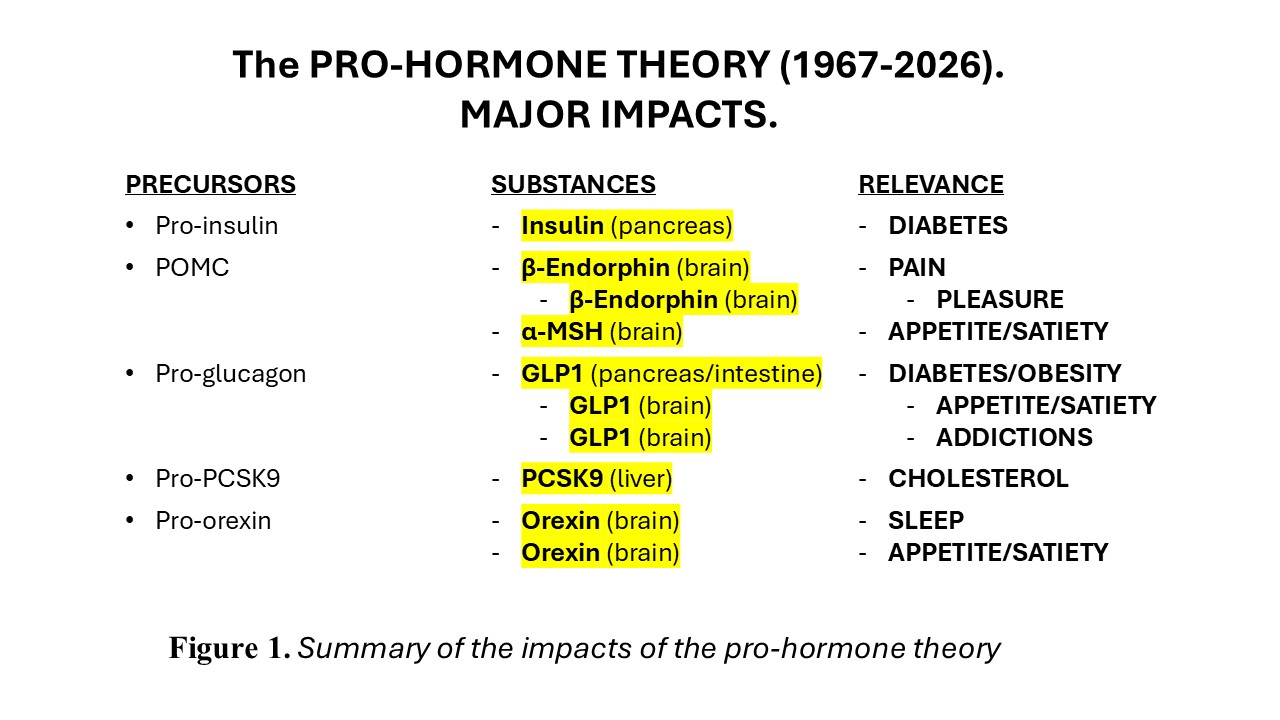
The Prohormone Theory opens a new chapter in human biology and applies to several diseases (4). It revolutionizes neuroendocrinology and homeostases (Fig. 1).
III. THE PCSK9Q152H MUTATION IN FRENCH CANADIANS
Due to its gain-of-function (GOF) mutations, PCSK9 is the third locus of familial hypercholesterolemia (FH) (26, 27). Even more impressive are the loss-of-function (LOF) mutations which lower plasma LDL-C. Thus, PCSK9 has led to revolutionary therapies for treating hypercholesterolemia (27).
Michel Chrétien discovered the hypocholesterolemic mutation PCSK9Q152H (28) in a French-Canadian family (Fig. 7). Its main characteristics are:
- It is present in only two other families in Quebec (29) and nowhere else in the world.
- It is one of the most hypocholesterolemic mutations in Caucasians (4,29) (Fig. 8).
- Among the thirty-three carriers of the mutation, three are homozygous (Fig. 8) (4) and three of the heterozygotes are centenarians.
- Located at the Pro-PCSK9 cleavage site, it results in a new protein, proPCSK9Q152H, which protects against heart disease and liver dysfunction (Fig. 9) (29).
- Finally, it is a prime target for gene therapy (30).
IV. DICITRISOIDES: TRITERPENE GLYCOSIDES AGAINST SARS-CoV-2 AND THE EBOLA VIRUS. (A DETOUR INTO VIROLOGY).
Based on the premise that cholesterol affects infectious diseases (31), including ma-laria, M. Mbikay demonstrates that LOF mutations of PCSK9 decrease infant mor-bidity and mortality caused by malaria (32,33). Simultaneously, he observes that isoquercetin (IQC) extracts decrease cholesterol and PCSK9.
Based on these two findings, the Chrétien/Mbikay duo, in collaboration with the Na-tional Microbiology Laboratory in Winnipeg, demonstrate that IQC is a potent antivi-ral against the Ebola virus (EB0V) and Zika virus (34,35). In 2020, they observed the same phenomenon against SARS-CoV-2, but this time with quercetin, the bioactive derivative of IQC (36).
Suspecting that the antiviral activity of IQC originated from contaminants rather than IQC itself, they discovered, in collaboration with Dr. Guido Pauli's group in Chicago, that the activity actually stemmed from two novel triterpene glycosides called dicitriosides (nDCTs) (Fig. 10)(37). These inhibit syncytia formation in specialized human HEK293 cells and prevent EBOV infection of Vero E6 monkey cells. Thus, these nDCTs are broad-spectrum antivirals with expanded therapeutic potential.
CONCLUSION
More than 50 years after its promulgation, the Prohormone Theory has become a major game changer in biology and medicine. Its importance is amplified by the potential existence of thousands of active substances derived from hundreds of pro-proteins cleaved by PCs (38). It is revolutionizing neuroendocrinology and leading to major clinical breakthroughs in diabetes, obesity, appetite-satiety, sleep, cholesterol, pain, and addiction (Fig. 1). The discovery of dicitriosides as a new antiviral is an important addition to the laboratory's portfolio.
Important Discoveries
|
Figure 1. Résumé des retombées de la théorie des pro-hormones |

|
Figure 2. La séquence de la β-MSH est enclavée dans la β-LPH entre des paires d’acides aminés basiques.
|

|
Figure 3. Référence aux cinq articles publiés sur le sujet.
|

|
Figure 4. La β-LPH est le précurseur de la β-MSH et la β-endorphine. |

|
Figure 5. Cascade biosynthétique complète de la POMC. |

|
Figure 6. La colocalisation de POMC et de ses peptides avec PC1 et PC2 confirme que ce sont les enzymes du clivage in vivo. |

|
Figure 7. Découverte fortuite d’une mutation unique de la PCSK9 chez une famille canadienne française. |

|
Figure 8. A: Une baisse marquée de la LDL-C chez les porteurs de la mutation Q152H, comparée au LDL-C des sujets contrôles des mêmes trois familles. |

|
Figure 9. La mutation produit une nouvelle protéine proPCSK9Q152H qui abaisse le LDL-C plasmatique et protège le foie de l’ER stress. |

|
Figure 10. Nous avons démontré que l’activité antivirale d’une préparation d’Isoquércitrine (IQC) commerciale pure à 90% provenait, non de ce flavonol, mais de la présence dans la préparation d’une infime quantité de triterpénoïdes glycosidiques (adaptée de Rebollar-Ramos et al. Journal of Natural Products, 89, np-2026-000775 doi: 10.1021/acs.jnatprod.6c00077 |

Tools
| Grants |
|
| Recognitions and honors |
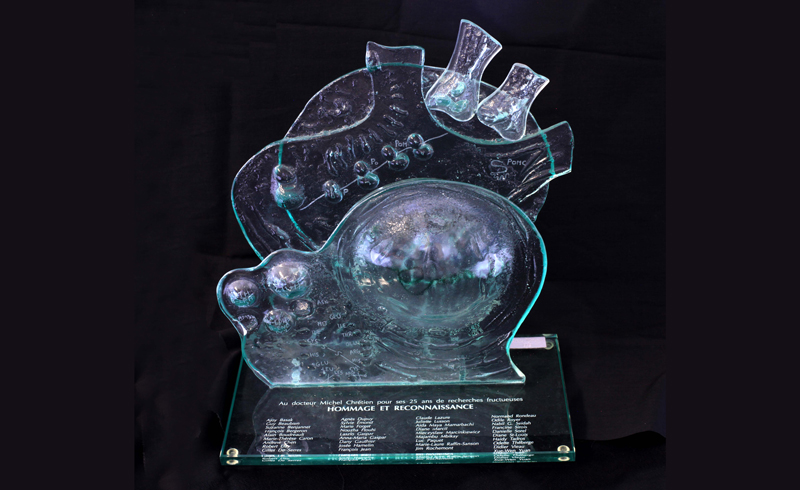
Cellular model of POMC, the precursor of beta-endorphin, ACTH and MSHs. Sculpture designed by Mrs. Suzanne Benjannet and realized by Mrs. Diane Mineau. |
Join the
group Research
Available positions
Ongoing clinical studies
Research Partners






Join the
research group
514 987-5664
michel.chretien@ircm.qc.ca
ACKNOWLEDGEMENTS
- Michel Chrétien pays tribute to his mentors: Jacques Genest, George Cahill, and Chao Hao Li.
- He expresses his gratitude to the many collaborators and colleagues who have supported him throughout his 65 years of scientific work*. He has supervised about a hundred students and interns who have made significant contributions. He is particularly grateful to Drs. Majambu Mbikay and Mieczyslaw Marcinkiewicz, both of whom are past the normal retirement age, for continuing their superb collaboration.
- He warmly thanks the IRCM, which enabled him to transform the THEORY OF PROHORMONES into a new chapter in biology and to bring about revolutionary breakthroughs in medicine.
- He thanks the funding agencies and foundations that have generously supported him since 1960, namely the CIHR, the CFI, the FRQS, the NIH (U.S.), as well as the following foundations: IRCM, J.A. DeSève, EJLB/Echo, Richard & Edit Strauss, Aclon (Geneva), J. Louis Lévesque, Jane Coffin (Yale), Macy (NY), Pizzagalli, Lazaridis Family (Waterloo), and Power Corporation of Canada.
* In particular, Susanne Benjannet, Nabil G. Seidah, Majambu Mbikay, Mieczyslaw Marcinkiewicz, Claude Lazure, Ajoy Basak, Janice Mayne, Francine Sirois, and Annie Roy.
Life in the
laboratory

110, ave des Pins West,
Montréal (Québec) Canada
H2W 1R7
514 987-5500


Partners

Research
Platforms
Student life
Admissions
The Institure
- A word from the president
- Our impact
- Our Legacy
- Governance
- Management Committee
- IRCM Awards
- Annual reports
Events
The Clinic
© Montreal Clinical Research Institute, Année.All rights reserves. | Privacy policy | Terms of use | Web site by Agence Riposte